

Stars this Month


If your browser objects to running scripts or ActiveX controls, it is the embedded 'Lightbox Image Viewer' javascript used to display these images in pop-up boxes. click 'Allow blocked content'.


The noted constellations pass overhead, mid month, at 9:30 pm for mid southern latitudes
Constellations for January

 ,
,  ,
, 
One of the twelve constellations of the Zodiac, Gemini has the Sun passing through it from late June to late July.
It lies between Taurus-The Bull in the west and faint Cancer-The Crab to the east. As darkness falls at the beginning of March its two brightest stars, Pollux and Castor can be seen high in the northern sky and 4 degrees apart. The southernmost and the brighter of the two, Pollux is an orange giant star and the nearest giant star to the Earth lying at a distance of only 34 light years. It appears yellowish to the naked eye. Castor, the second of the twins is 52 light years away and is actually a system of six stars all bound to each other by gravity forming one of the most remarkable examples of a multiple star system in the heavens.
To the naked eye Castor appears as a blue-white star but even small telescopes will separate the two main stars
of this system into individual stars. These two stars orbit a common centre of gravity once every 470 years.
Castor and Pollux represent the heads of the twins and their bodies are depicted by two parallel lines of fainter stars heading off in a westerly direction like two stick figures. The constellation is best observed in a dark moonless sky away from the town lights.
Gemini also contains quite a few nice star clusters that are worth a look at through binoculars and the Geminid meteor shower appears to radiate from this constellation from December 7th to December 17th.
The planet Uranus and dwarf planet Pluto were both in Gemini when discovered.
Constellations for February

 ,
,  ,
,  ,
, 
Looking like fragments that have broken off the Milky Way and lying very close to the South Celestial Pole, the Magellanic Clouds are only clearly visible from the southern hemisphere. They are two of the nearest known galaxies to the Milky Way Galaxy and are easily visible to the naked eye high in the southern night sky on a moonless night. They were first reported in Europe by the survivors of Ferdinand Magellan's voyage around the Earth in 1615 but were not given their present names on star maps until much later. Their formal astronomical names are "Nebecula Major" and "Nebecula Minor".
Though they appear quite close together in the sky they are in fact around 75,000 light years apart. There is a stream of cold hydrogen gas being pulled from the large cloud toward the Milky Way Galaxy, the result of a close passage of the Milky Way more than 200 million years ago. The stream contains about 1 billion times as much mass as our Sun. Until recently they were thought to be satellite galaxies of the Milky Way but current studies of their radial velocity seem to indicate that they are passing by at a rate of 480km/second, much too fast to be captured by the gravity of the Milky Way.
The large cloud lies at a distance of 160,000 light years and is located in the constellation Dorado - The Goldfish.
It has a diameter of roughly 32,000 light years and contains around 15 billion stars. To the naked eye it appears as a fuzzy patch of light 12 times the apparent diameter of the moon. Astronomers around the world were excited when on the 24th of February 1987 one of the stars in the cloud exploded into a supernova and became 10,000 times brighter than it normally is. At its brightest it was brighter than all of the stars in the cloud put together and was the first naked eye supernova since 1604.
The small cloud is 230,000 light years away and resides in the constellation Tucana - The Toucan. It contains around 4 billion stars and is visible to the naked eye as a nebulous tadpole shaped patch 3.5 degrees across. Both clouds are visible all year round from the location of Mudgee.
Constellations for March

 ,
,  ,
, 
The constellation Leo is one of the few constellations that looks like the figure that it is supposed to represent, a crouching lion, even though it appears upside down for us here n the southern hemisphere. The head of the lion is marked by six stars in the shape of an upside down question mark, the southern most star of these six being Regulus the brightest star in the constellation. The body of the lion stretches out for about 28 degrees to the star Denebola (the tail of the lion).
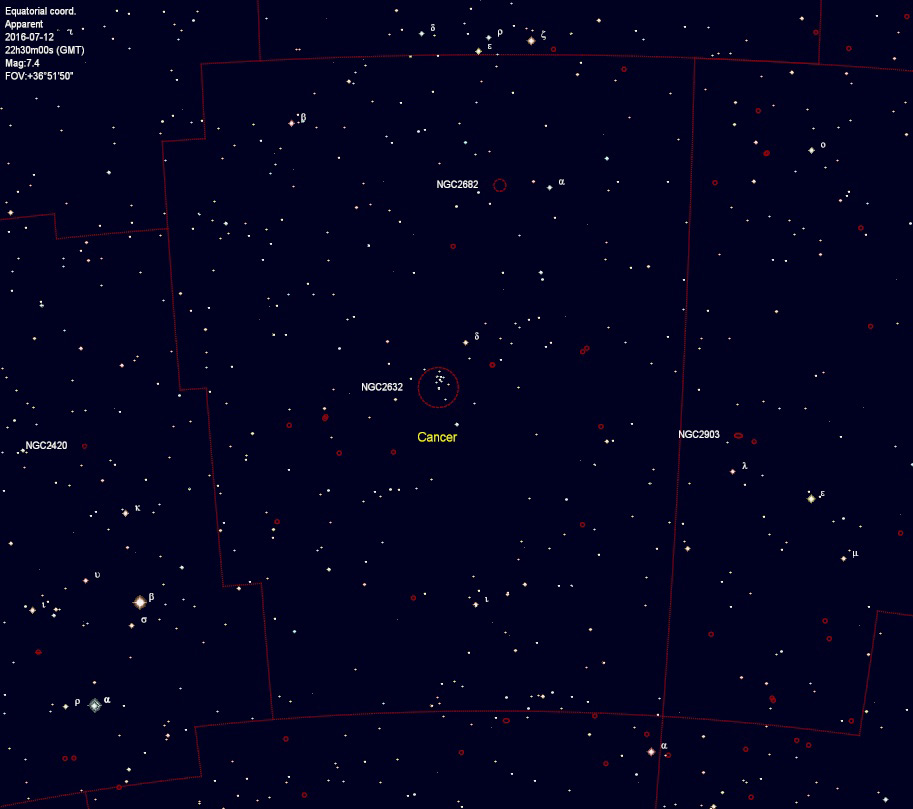
About twenty degrees to the west of Regulus you will notice a small fuzzy diffuse patch of light. This is commonly called the Beehive Cluster and consists of about 75 stars in a group covering 1.5 degrees of the sky.
This cluster is actually located in the constellation of Cancer - the crab, where there are no bright stars and is best observed with binoculars when there is no Moon in the sky.
Constellations for April

 ,
,  ,
, 
Sirius-The Dog Star. About twenty degrees to the south east of Orion's belt lies the constellation of Canis
Major-The Greater Dog. This is an ancient constellation which represents one of Orion-The Hunter's faithful hounds. It contains many bright stars including Sirius, the brightest star in the sky which, at a distance of 8.6 light years it is one of the sun's nearest neighbors. Sirius is actually a double star as it has a white dwarf companion which orbits the main star once every fifty years. This companion, Sirius B was the first of this type of star to be found and its presence was detected by the wobble it introduced into its parent star.
Because of the brightness of the main star it is very hard to observe Sirius B in small to medium size telescopes.
Also of interest in the constellation is the open star cluster M41. It lies just four degrees to the south of Sirius and can be seen with the naked eye under dark sky conditions. A small telescope will show it as a group of about fifty closely knit stars. M41 lies at a distance of 2100 light years and covers an area of the sky roughly equal to the full moon.
As April begins, Canis Major can be found high overhead and just west of the meridian.
Constellations for May

 ,
,  ,
,  ,
,  ,
,  ,
, 
The constellation Virgo is the second largest constellation in the sky and the only female among the constellations of the Zodiac. It lies between the constellations of Libra-The Scales and Leo-The Lion. She is often seen as a beautiful and virtuous maiden, the Roman goddess of justice, with neighboring Libra representing her scales of justice.
The Sun passes through Virgo from mid-September to early November and thus is within Virgo's boundaries as the Sun crosses the celestial equator on its southward journey at the beginning of Spring in the southern hemisphere.
The constellations brightest star, Spica is the sixteenth brightest star in the sky and is a blue white star with a companion that passes in front of it every four days. This eclipsing star lowers the brightness of the main star very slightly but not enough to be readily noticeable with the naked eye. Spica is twice the size of the Sun but is in fact two thousand times brighter than the Sun and lies at a distance of 262 light years from The Earth. At the beginning of April it rises at 6:00pm and is visible all night long, crossing the meridian just after midnight about 60 degrees above the northern horizon. Don't be fooled by another star Arcturus which is much brighter and 32 degrees closer to the northern horizon. Virgo contains a rich cluster of galaxies, some of which can be seen in moderately sized telescopes. This cluster is the nearest major galactic cluster to us and is 65 million light years away containing around 3000 members.
Constellations for June

 ,
,  ,
,  ,
, 
Scorpius is one of the few constellations which clearly appears like the creature it represents and the bright stars that form its shape can easily be seen against the fainter stars of the Milky Way. Its heart is marked by its brightest star Antares, a name that means "the rival of Mars" because of its reddish colour. This star is a red supergiant that is at least 300 times the size of the Sun and lies at a distance of 600 light years. The star at the end of the scorpion's tail is Shaula, the sting, which is a blue-white star 700
light years away. Dschubba, the forehead, is the star that marks the head of the scorpion is also a blue-white star that lies at a distance of 400 light years.
There are some interesting open and globular star clusters in the Scorpius part of the sky and it can be very rewarding to take a look around this area with a telescope or even binoculars if you have them. In ancient mythology, Scorpius was the creature that killed Orion, the mighty hunter, with his sting. Orion still flees from the scorpion, for as Scorpius rises over the eastern horizon Orion sets in the west.
Constellations for July

 ,
,  ,
,  ,
,  ,
,
The Southern Cross (Crux) is the smallest of the 88 constellations and probably the most recognized by
Southern Hemisphere dwellers. It consists of four bright stars forming the well known cross shape and a
fifth star which appears as a "misplaced central star". Its stars decrease in brightness in a clockwise direction starting at its brightest star Acrux which is the bottom star in the long arm of the cross and lies at a distance of 360 light years. To the naked eye this star appears as a single star but a telescope shows it to consist of two blue-white components lying very close together.
The second brightest star, Beta Crux (Mimosa) is also a blue-white star which fluctuates in brightness every 6 hours and is 370 light years away. These changes in brightness are very subtle and delicate instruments are required to detect them.
The top star in the cross, Gamma Crux and the third brightest is a red giant and lies at a distance of 88 light years. If you look closely you can detect a definite orange tinge to it. Delta Crux is the faintest star that makes up the shape of the cross and is a white star 470 light years away.
To the south-east of Beta Crux and only 1 degree away lies the beautiful Jewel Box star cluster which , to the naked eye, appears as a faint fuzzy patch of light. A telescope reveals a group of around 50 stars of various colours mostly blue, white and orange resembling a sparkling piece of multicoloured jewelry. Just below the Jewel Box and lying 600 light years away is the Coalsack, a vast cloud of interstellar dust which blocks the light of distant stars and forms what seems to be a large hole in the Milky Way. It is easy to see with the naked eye and is one of the sky's largest and densest dark nebulae.
In July the Southern Cross can be found high in the southern sky just after nightfall.
Constellations for August

 ,
,  ,
,  ,
,  ,
, 
The constellation of Sagittarius is one of the ancient constellations and depicts a centaur, half man and half beast, with a raised bow and arrow. The arrow is aimed at the heart of Scorpius, The Scorpion, and its nearest western zodiacal neighbor. Sagittarius was seen by the ancient Sumerian civilization as Nergal, their archer god of war. The centre of the Milky Way Galaxy lies in Sagittarius making this area of sky very rich in galactic nebulosity and star fields. Many people identify the constellation by the shape of a teapot outlined by its brightest stars with the clouds of the Milky Way representing the steam rising from its spout.
The sun passes through the constellation from mid-December to mid-January during the summer solstice
when it is at its maximum distance south of the equator. After sunset early in November Sagittarius can be found in the western sky just above the hooked shape of the Scorpion's tail.
Constellations for September

 ,
,  ,
,  ,
, 
Capricornus has been known since Babylonian and Chaldean times. It is represented as a goat with the tail of a fish. It is also one of the dimmest constellations in the sky. Most of the stars are 3rd magnitude or dimmer. This constellation contains the globular cluster M30. Alpha Capricorni is a nice multiple star.
Cygnus the Swan has the famous "Albirio" a beautiful yellow and blue double star at the tip of the "beak". Deneb, the brightest star in Cygnus, forms a large triangle with two other stars, Altair and Vega. This prominent formation of bright stars is known as the summer triangle. The well known but faint "Veil" Nebula is a whispy super nova remnant.
Vulpecula, the Fox, was introduced by Johannes Hevelius. The constellation resembles a flying gull seen face-on. This is the home of the Dumbbell Nebula. This planetary nebula gets its name from its hourglass shape, which resembles a dumbbell used for weight lifting.
Delphinus, the Dolphin, is located just west of Pegasus. It bears a remarkable resemblance to a dolphin leaping out of the water. Because of this shape, it is easy to recognize in the sky.
Constellations for October

 ,
,  ,
,  ,
, 
Tucana was invented by Johann Bayer and is one of three exotic birds, which are grouped around the South Pole. Home of the Small Magellanic Cloud, a satellite galaxy of the Milky Way. Next to it the magnificent globular cluster NGC 104 is viewed, it is also known as 47 Tuc.
Aquarius is represented as a man pouring water from a bucket. This ancient constellation has its roots in many a number of cultures. In Greek mythology, Aquarius was Ganymede, the cupbearer to the gods. The notable "Helix" nebula is high and a well known target for southern observers.
Grus the Crane looks like a radio telescope dish and hosts several nice galaxies.
Pegasus is visible from August through December. It represents the son of Neptune and Medusa who eventually became the thundering horse of Zeus and the carrier of his lightning bolts. Visible from southern sky as the great square. Home to the globular cluster M15 and several nice galaxies.
Constellations for November

 ,
,  ,
,  ,
, 
Situated in the constellation of Andromeda this great galaxy lies at a distance of 2.5 million light years and is the most distant object detectable with the naked eye. It is the nearest large galaxy to the Milky Way Galaxy in which our own Sun resides. Recent observations reveal that it contains 1 trillion stars and is 141,000 light years wide, making it about 50% larger than our own galaxy. It is hurtling toward the Milky Way at a speed of 300 kilometers per second and the two galaxies will probably merge in around 3 billion years. Seen from the Earth it has a 15 degrees tilt from the edge on position and as December begins it can be seen as a faint elliptical shaped fuzzy patch about 12 degrees above the north western horizon.
It is best observed with binoculars when there is no moon in the sky and away from the lights of the town. It lies due north at midnight on September the 30th, at 11pm October the 15th, and at 10pm October the 30th.
Constellations for December

 ,
,  ,
, 
Aries is an ancient constellation, which was known as the Ram to the Babylonians, the Egyptians, the Greeks and the Persians. In Greek mythology, it represents the ram from which the golden fleece was obtained in the story of Jason and the Argonauts.
Cetus represents the sea monster sent by Neptune to devour Andromeda. Cetus was turned to stone when Perseus showed the monster the head of Medusa. Cetus has also been identified as the Biblically famous whale that swallowed Jonah. Hosts the bright cored galaxy M77 and several other nice ones. Mira (Omicron Ceti) is a famous variable star also known as the "Demon" star.
Triangulum is one of the original 48 constellations first drawn by Ptolemy. In ancient times, its distinctive shape of three stars was called Deltoton. It is host to the nearby galaxy M33 about 2.5 million light years away.